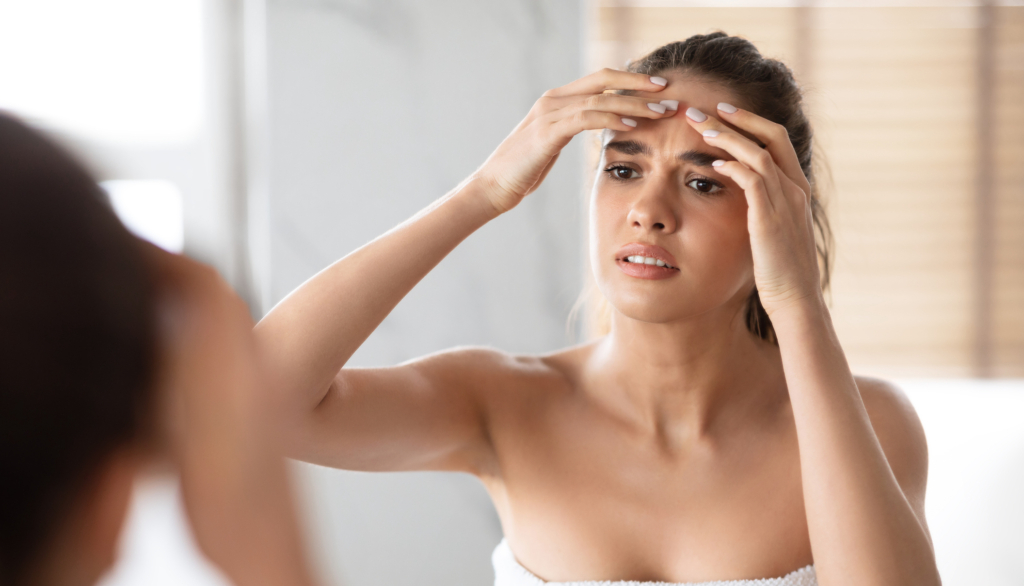
You’re not alone with this problem. Medical studies have now established that cycle-related hormonal fluctuations strongly influence our skin. Over the course of the cycle, many women show typical patterns in the form of skin blemishes.
You have a decisive advantage here: scientific findings give you a certain degree of predictability. If your skin only tends toward acne and blemishes during a specific phase of your cycle, you can calculate exactly when your breakouts will appear and, ideally, intervene preventively.
How this works and how you can do your skin a favor even during difficult times is what we explain in our article about breakouts after ovulation.
Breakouts and Ovulation: These Hormones Affect Your Skin
Every month, the female body realigns itself by going through the four phases of the cycle – from menstruation (approx. day 1–6), the follicular phase (approx. day 6–11), ovulation (approx. day 12–16), to the luteal phase (approx. day 17–28) – while producing different sex hormones. This creates a timeline all its own inside you, one that has nothing to do with the 24/7 rhythm of our working world.
The cycle begins with your period. During this phase, the body produces more of the female sex hormone estrogen. Estrogen acts as a mood booster in the emotional areas of your brain – which also explains why you feel so incredibly good during the first half of your cycle. Researchers also believe that estrogen has a dampening effect on your sebaceous glands and additionally promotes good collagen production in your skin. The androgen testosterone, wrongly labeled as “male,” also rises noticeably in the first half of the cycle up to ovulation and boosts your libido.
After ovulation, progesterone joins the hormone mix, while at the same time the strongest of the three naturally produced estrogens – estradiol – slowly declines until the next period. In some women these fluctuations go unnoticed, but in most they show up as mood swings and breakouts.
In This Cycle Phase Your Skin Tends Toward Blemishes
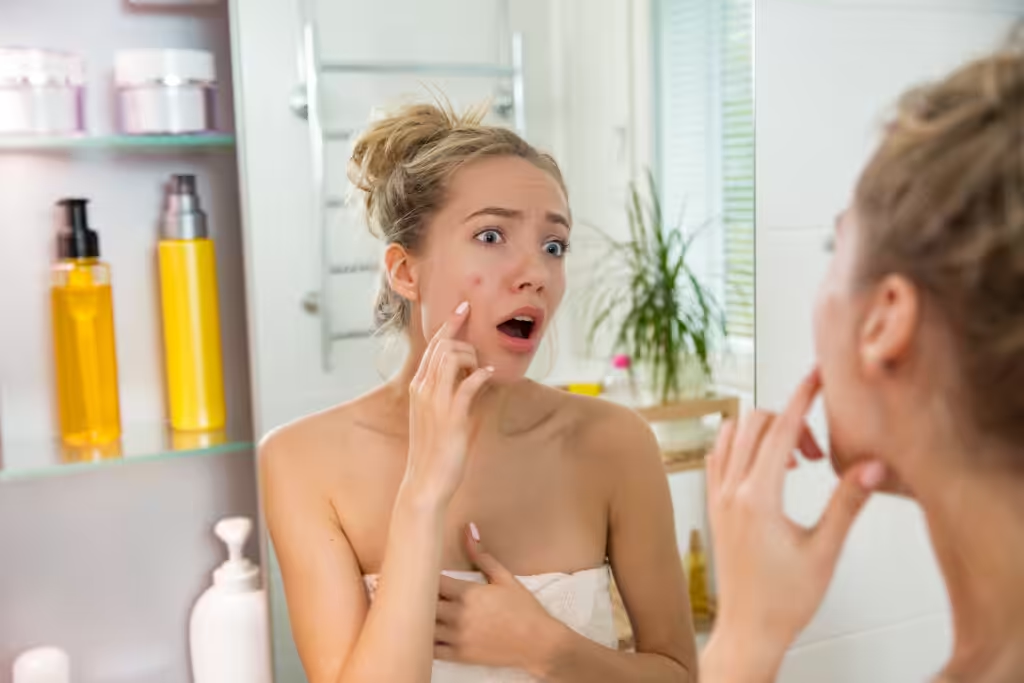
Breakouts tend to occur especially in the second half of your cycle, the luteal phase after ovulation. You can go ahead and mark the span between cycle day 17 and day 28 in your calendar, because thanks to your unfavorable hormone balance, your skin will be at its worst when it comes to impure skin.
But why is that actually the case? The cause of your skin blemishes lies in the decline of estrogen and testosterone production after ovulation (without conception). Instead, a lot of progesterone now comes into play, which tends to stimulate the sebaceous glands. As a result, your skin becomes oilier faster, and bacteria feel especially at home due to the increased body temperature.
Before your period starts, all sex hormones are also in a nosedive, which you can read directly on your skin. If you already naturally suffer from skin that becomes oily quickly, this phase tends to bring on blackheads and hormonally caused breakouts after ovulation as well. But women with rather dry skin also have to deal with unpleasant skin irritations during the luteal phase, such as eczema, psoriasis, or intense itching.
Sometimes skin problems can even indicate a hormonal disorder – for example a thyroid condition or polycystic ovary syndrome (PCOS). If your cycle-related skin blemishes are particularly severe, you should definitely get advice from a dermatologist – who can also determine your skin type.
But even without a diagnosis, you may benefit from cosmetic treatments such as microdermabrasion in Berlin Mitte or an Aquafacial in Berlin Mitte, which can help your inflamed breakouts after ovulation in the luteal phase clear up faster. With microdermabrasion, for example, your skin is stimulated to form new, stronger cells through a painless removal of dead skin cells. Want to do something good for your skin already in the first half of your cycle? Microneedling in Berlin Mitte firms your skin and helps regenerate (acne) scars, wrinkles, or sun-damaged areas of skin.
Source: Suzi Media Production/iStock
Breakouts and Ovulation: Solutions for Blemishes After Ovulation
If you want to get by without hormonal preparations like the pill and similar options, there’s still a lot you can do to ease cycle-dependent skin problems and recognize them early.
Step 1: Get to Know Your Cycle
Knowledge is half the battle. If you don’t already use a cycle-tracking app, you should definitely download Clue, Ovy, or FLO. In these apps, you not only get your next ovulation calculated for you, but you can also log how your skin feels on a given day.
Observe and note exactly how your skin changes over the course of your cycle. When does it show its best side? When is your complexion uneven? Is the problem breakouts before ovulation or after ovulation?
The better you get to know your cycle and your skin, the more control you have over breakouts around ovulation, and the calmer you can react when the monthly blemishes suddenly show up on your face again.
Step 2: Analyze Your Lifestyle
It’s now well researched that lifestyle has an enormous influence on our skin. While some women react to an excess of sugar with skin problems, others get breakouts when they consume dairy products like yogurt or cheese. It’s also no longer a secret that alcohol and cigarettes further weaken the skin barrier and promote inflammation, while fresh fruit and vegetables as well as nuts contribute to beautiful skin from within. Stress also has negative effects on your skin, leaving its mark through consequences like lack of sleep, a poor skincare routine, and late-night fast-food binges.
Try documenting not just your cycle but also your lifestyle for one to three months, so you can rule out a connection between poor diet, alcohol consumption, and cycle-related breakouts. Are there foods that worsen or improve your skin? Which skincare products do you use, and how does your skin react to them? How much do you sleep each day, and do you spend time outdoors in the fresh air?
Step 3: Take Concrete Action Against Breakouts After Ovulation
You know when your luteal phase begins and you already pay meticulous attention to your lifestyle – but the annoying breakouts after ovulation simply won’t go away? Then it’s time to actively do something for your skin and turn to peels, masks, or an appointment at your favorite beauty studio.
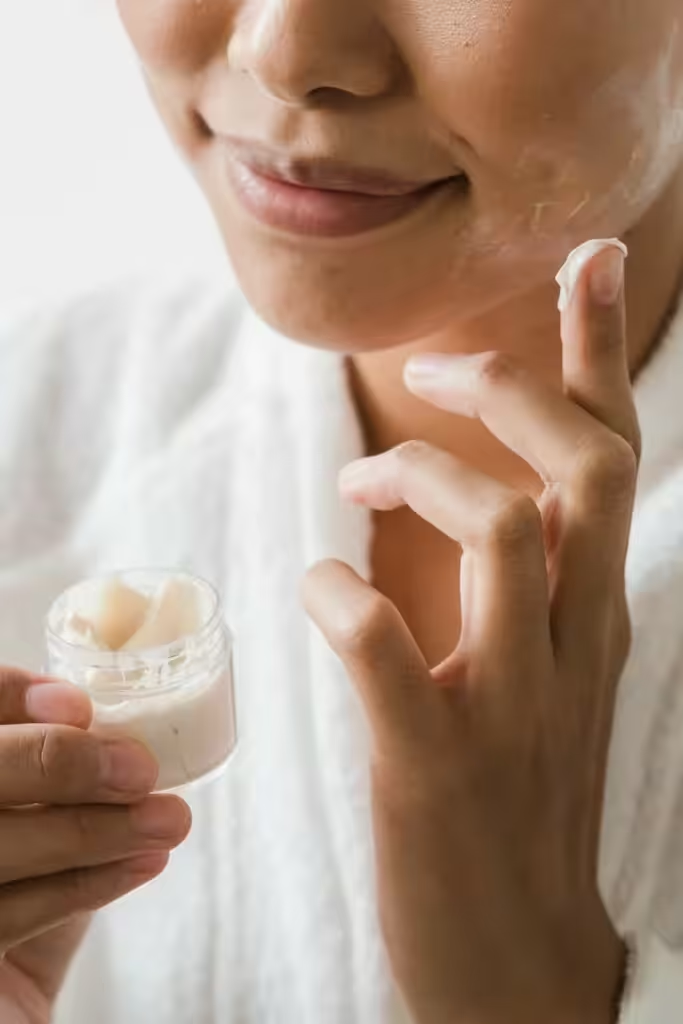
Gentle peels with salicylic acid, for example, help free clogged pores of dead skin cells, sebum, and dirt. There’s also a rule of thumb: touch your face as little as possible, because many bacteria cling to your fingers, further encouraging breakouts to form. If you still tend toward acne, we recommend using SOS skincare products with zinc or antibacterial ingredients, which soothe the inflammation and speed up healing. You’ll find more practical approaches for SOS care in our article on home remedies for acne.
Source: Greta Hoffman/pexels
Breakouts and Ovulation: Conclusion on Hormonally Caused Blemishes
The female cycle doesn’t just influence our wellbeing and energy levels, but also our outward appearance. The body’s own hormones constantly send signals to the brain, determine how much fat we store, make us laugh, and change our skin. It’s all the more remarkable that we so often forget this natural process when it comes to a holistic view of our health.
In this article, we’ve given you an initial overview of the four cycle phases and the hormones that flow through your body during this time. To understand in the long run why breakouts occur especially during the ovulation and luteal phases, it’s essential to keep learning about your cycle. You can do this by using certain period-tracking apps or by keeping an analog cycle journal. Books like Sina Oberle’s Der Zyklus-Code or Nora Konrad’s Die Kraft deines Zyklus are also a great way to develop your own, holistic concept for greater wellbeing.
What matters most is that you don’t stress yourself unnecessarily if one of these troublemakers shows up on your face again. Even the best prevention can’t always keep breakouts after ovulation at bay. If, during this tricky cycle phase, you feel the need for a treatment like acne treatment in Berlin, don’t hesitate to contact us and stop by our studio in Berlin Mitte. \