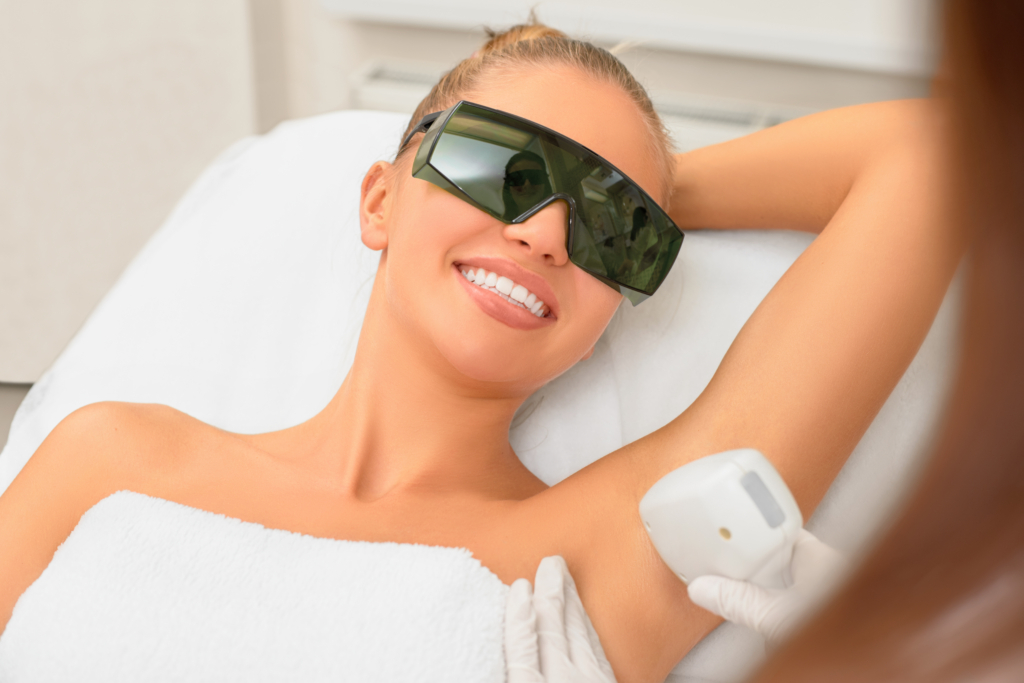
Are you plagued by an ingrown hair in the intimate area? Then professional laser hair removal at a beauty salon is ideal for you! Over the course of several sessions, annoying hairs are permanently removed. This way, you can enjoy hair-free skin every day once your treatment is complete.
Before you can get started, however, you should take a close look at preparing for laser hair removal so that you can benefit from perfect results afterwards. In our article, you’ll learn what you should avoid before your laser hair removal and why tattoos and medications can become problematic.
Laser hair removal preparation: how permanent hair removal works
If you’re considering laser hair removal, you should first familiarise yourself with how the procedure works so that you can prepare for it optimally. During laser hair removal, laser light of a specific wavelength is targeted at the hair, where it is absorbed by the pigment melanin. This allows it to reach the stem cells of the hair follicle, where it is ultimately converted into heat. This damages the surrounding cell structures responsible for hair regrowth. This reaction can cause the hair to grow more slowly or disappear altogether.
The result depends on the following factors:
- The correct choice of laser type – depending on hair type and skin phototype.
- The right choice of parameters used throughout the treatments.
- Adherence to the intervals between treatments for each area of skin.
The type of laser hair removal is determined by the laser type, i.e. the wavelength of light with which the device works. There are alexandrite, diode, and Nd:YAG lasers.
Another important piece of information for preparing for laser hair removal is whether the device being used is a certified medical device, or whether the treatment is being carried out with unclear effectiveness and side effects.
When choosing a laser, you should rely on a qualified beautician you trust. Professionals know what type of hair and skin you have – and which laser is therefore suitable for your permanent hair removal.
At Sanft & Schön, we exclusively use a 3-wavelength diode laser that can be set to wavelengths of 755 nm, 808 nm, or 1064 nm – ideal for reaching deep-seated hair follicles and treating thick hair (e.g. on the back). Laser hair removal is especially effective if you have light skin and dark hair – but all other skin and hair types can also be treated gently and effectively with us. At Sanft & Schön, we guarantee that we work with the latest devices and at a medical standard, so you can be sure that the best possible results are achieved for you!
What should your laser hair removal preparation include?
One of the most frequently asked questions in our salon concerns preparing for laser hair removal – and that doesn’t surprise us. After all, safety and protection come first, and good preparation reduces the risks of laser hair removal.
Laser hair removal preparation: transparent communication is important
Transparency is also the key to success in laser hair removal: tell your beautician everything about your skin, as it’s crucial for the results. If you fail to mention, for example, that you’ve recently been to the beach or that you plan to expose yourself to the sun or a sunbed earlier than recommended, this can lead to serious, unintended damage such as pigmentation disorders or even burns.
Laser hair removal preparation: your tan is now beside the point
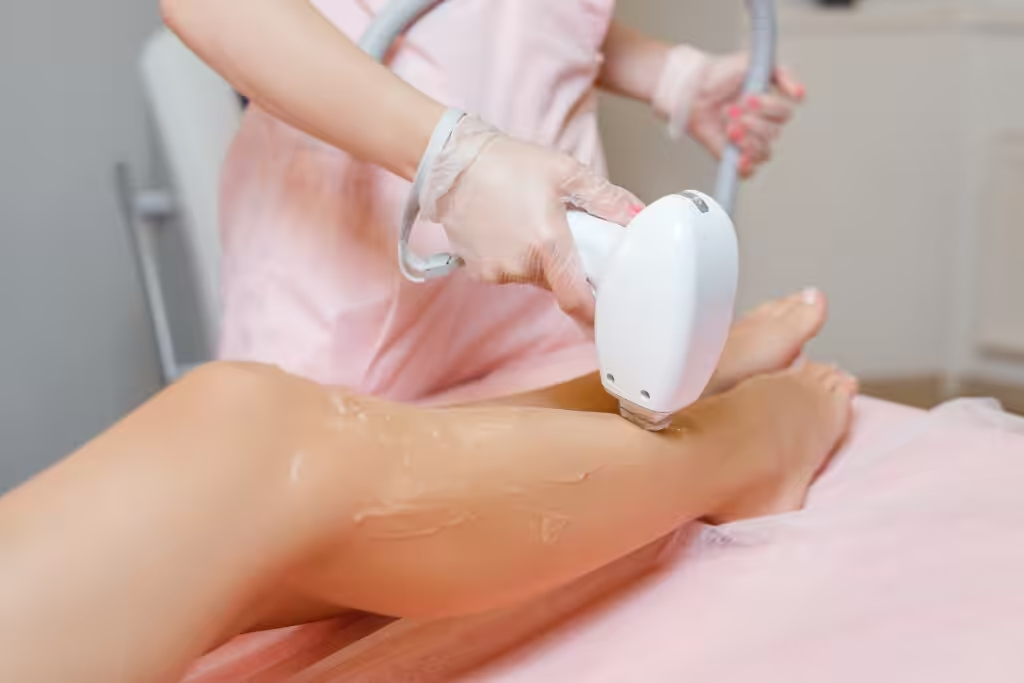
Sun exposure is absolutely forbidden before and after laser hair removal. Don’t visit a sunbed and avoid any form of artificial tanning for at least two weeks before your treatment. The medical alexandrite laser used for hair removal, for example, targets the melanin in the hair shaft with very strong energy. If the skin contains as much or even more melanin than the hair, this can lead to pigmentation disorders or burns.
Pigment changes can be particularly noticeable under the arms; find out how to deal with darker underarms in our article on dark underarms.
That’s why we advise you: sacrifice one tan-free summer for all the summers to come with carefree, smooth skin. There are lasers that can work on tanned skin too – but their effect doesn’t last.
Use sunscreen to prepare for laser hair removal
Apply a sunscreen with at least SPF 50 to the treated area of skin every day for the entire duration of your hair removal treatment. This prevents the area from darkening or burning. If the treated skin darkens, we’re forced to use lower or safer parameters, even if we wait two weeks after your last sun exposure before performing laser hair removal. This is because we’re careful to avoid damaging the skin – rather than increasing the pulse intensity at each subsequent visit, as would be recommended for maximum effectiveness. This can affect your results, and we may need to carry out additional treatments.
Don’t use exfoliants before or after laser treatment
It’s important that you don’t use any exfoliants for ten days before and after hair removal: every exfoliation causes small injuries to the skin, which puts additional strain on it. Possible effects include irritation, dryness, tightness, or burning. If your skin is already irritated before laser hair removal, the treatment can become painful, and serious injuries can occur. Protect your skin before and after laser hair removal and avoid mechanical and chemical exfoliants for the time being.
Avoid permanent hair removal methods for three weeks to prepare for laser hair removal
So that the laser can optimally remove your annoying hairs, you should avoid removing hair in the treatment area with wax or other methods for at least three weeks before your first laser hair removal session. This is because laser hair removal only works if the hair is still connected to its root.
The reason for this is the laser technology mentioned earlier: the laser light is absorbed by the melanin in the hair shaft, conducted down to the hair root, and converted into intense heat there, destroying the follicle. If you’ve epilated or waxed shortly before your laser hair removal, the hairs were removed along with their roots. If the laser doesn’t hit a hair root, it unfortunately has no effect.
Laser hair removal preparation: trim or shave between treatments
Between two treatments, you should only remove hair by shaving or trimming. Don’t worry, this won’t make your hair thicker or darker – quite the opposite: after your first laser hair removal session, your hair will become thinner, finer, and will grow much more slowly, or not at all.
As part of your laser hair removal preparation, you should trim or shave your hair the evening before your appointment, so that your skin isn’t additionally irritated the next day by shaving immediately before the treatment. Shave the area to be treated carefully, as longer hair can lead to unpleasant side effects: on the one hand, the laser treatment can become very painful, and on the other, the hair removal becomes significantly less effective, as the pulse energy is lost along the length of the hair instead of reaching all the way down to the hair root.
Therefore, use a razor or a trimmer to remove your hair, but never a hair removal cream. These contain acids that damage the skin and can trigger a reaction with the laser. Have you accidentally used a hair removal cream in the area to be treated? Then it’s best to postpone your laser appointment by at least seven days.

Why is preparing for laser hair removal important?
Laser hair removal is a demanding procedure that is applied to sensitive areas of your body. Those who are familiar with the science behind the technology have a higher chance of achieving the desired results and avoiding unwanted side effects.
Keep in mind that the normal hair growth cycle lasts about six weeks. For facial hair, it’s somewhat shorter. As a rule, an average of six to eight treatments are required to achieve maximum results. The interval between two treatments is usually up to six weeks for the face and up to eight weeks for the body – in some cases, you may even need to wait up to three months. These intervals should absolutely be observed, as shortening them can lead to unsatisfactory final results.
Preparing for laser hair removal should also include the following:
- Examination by a dermatologist. We recommend having a dermatologist examine you, reviewing your medical history, and discussing your expectations for the procedure together.
- Perfumes. Please avoid using irritating substances in the relevant area before and after the treatment.
- Collagen injections and fillers. Please consult your specialist if you’ve had an aesthetic injection in the treatment area within the last six months.
- Taking medication. Some prescription medications and certain antibiotics have photosensitising effects. Taking them during treatment can lead to hyperpigmentation later on. You must inform your beautician if you’re taking these medications. It’s best to seek advice from your doctor: they can assess whether laser hair removal is safe while taking medication.
- Tattoos. Special patches must be applied before the procedure to prevent burns. Dark tattoos absorb a large amount of laser energy due to their specific pigments.
Conclusion: preparing for laser hair removal
Whether it’s your legs, arms, upper lip, sideburns, intimate area, or laser hair removal for men: proper preparation for laser hair removal determines the success of the treatment.
Before your laser hair removal, be sure to avoid anything that would additionally irritate your skin in the areas to be treated: exfoliants, sun exposure, or other hair removal methods such as hair removal creams, waxing, or epilation should be off-limits for you.
However, make sure you trim or shave your hair with a razor or trimmer and don’t show up to your laser appointment with long hair. Only then can the laser energy penetrate deep into the hair root and remove your hair permanently.
Caution is also advised after cosmetic procedures, when taking medication, and with tattoos: it’s best to consult with your treating doctor to rule out the possibility that laser hair removal could cause physical discomfort.